|
|
|
|||
|
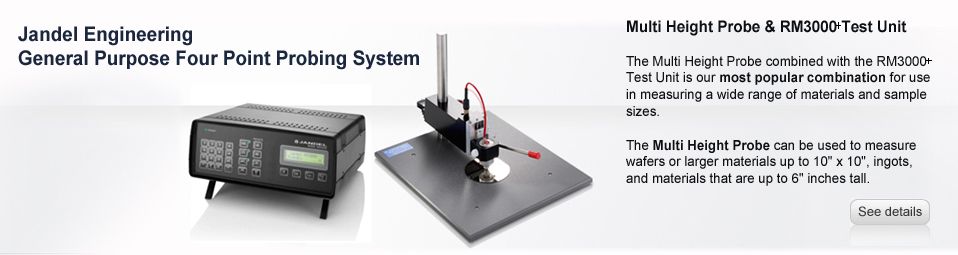
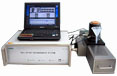
Manual Four Point Probing System ![]() The Multi Height Probe combined with the RM3-AR Test Unit is our most popular combination for use in measuring a wide range of materials and sample sizes. The Multi Height probe can be used to measure wafers or larger materials up to 10" x 10", ingots, and materials that are up to 6" inches tall. A longer post option allows even taller materials to be measured. The measurement range of the RM3-AR Test Unit is from 1 milliohm-per-square (10^-3) up to 5 x 10^8 ohms-per-square with 0.3% accuracy. The volume resistivity range is from 1 milliohm-cm (10^-3) up to 10^6 ohms-cm. Windows based application software is included with the RM3-AR for storing data and conversion to either bulk resistivity or sheet resistance. The RM3-AR auto ranges to determine the proper input current. It reads-out directly in sheet resistance without using a PC. Click here to download a PDF document regarding the Multi Height Probe combined with the RM3-AR Test Unit. Click here to visit the web page for the Multi Height Probe combined with the RM3-AR Test Unit. |
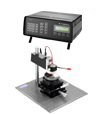
Manual Four Point Probing System ![]() The Multi Height Microposition Probe combined with the RM3-AR Test Unit is Jandel's most versatile four point probing system. It includes a fine X-Y stage for positioning small samples under the four point probe tips. The X-Y stage can be easily removed for measuring large samples such as substrates up to 10" x 10", or tall materials up to 6" tall. The measurement range of the RM3-AR Test Unit is from 1 milliohm-per-square (10^-3) up to 5 x 10^8 ohms-per-square with 0.3% accuracy. The volume resistivity range is from 1 milliohm-cm (10^-3) up to 10^6 ohms-cm. Windows based application software is included with the RM3-AR for storing data and conversion to either bulk resistivity or sheet resistance. The RM3-AR auto ranges to determine the proper input current. It reads-out directly in sheet resistance without using a PC. Click here to download a PDF document regarding the Multi Height Probe combined with the RM3-AR Test Unit. Click here to visit the web page for the Multi Height Microposition Probe combined with the RM3-AR Test Unit. |
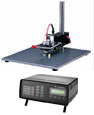
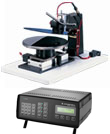
![]() The Multiposition Wafer Probe combined with the RM3-AR Test Unit provides a high quality, easy to use system for measuring the sheet resistance and/or volume resistivity of wafers up to 200mm (8") in diameter. This system has the ability to probe 1, 5, 9, or somewhat more positions on multiple wafers with 1mm positioning repeatability from wafer to wafer. The measurement range of the RM3-AR Test Unit is from 1 milliohm-per-square (10^-3) up to 5 x 10^8 ohms-per-square with 0.3% accuracy. The volume resistivity range is from 1 milliohm-cm (10^-3) up to 10^6 ohms-cm. Windows based application software is included with the RM3-AR for storing data and conversion to either bulk resistivity or sheet resistance. The RM3-AR auto ranges to determine the proper input current. It reads-out directly in sheet resistance without using a PC. Click here to download a PDF document regarding the Multiposition Wafer Probe combined with the RM3-AR Test Unit. Click here to visit the web page for the Multiposition Wafer Probe combined with the RM3-AR Test Unit. |
Ecopia HMS-5000 Hall Effect Measurement System ![]() The Ecopia HMS-5000 Hall Effect Measurement System is a complete system for measuring the resistivity, carrier concentration, and mobility of semiconductors. The system includes variable temperature control in the range form 80K to 350K, and has motorized magnet movement. It can be used to characterize various material including silicon, compound semiconductors, metals, oxides, etc.. Click the image above to go to the web page where the brochure and operating manual can be downloaded. |
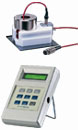
![]() The Hand Applied Probe combined with the HM21 Hand Held Meter is a high quality portable four point probe measurement system which incorporates the Jandel Cylindrical probe head. The system can be used to measure a wide range of materials with varying shapes and sizes. The Hand Applied Probe is ideally suited for use in measuring large substrates and flat panels, however, it can be used to measure wafers and even small samples as well. When measuring small samples, you will sometimes need another piece or two of the same thickness of material underneath the back side of the probe body so that the entire unit rests on the material in the same plane, i.e., to keep it level. A discussion of using the Hand Applied Probe on small samples can be seen on page four of the following PDF file: http://www.fourpointprobes.com/jandel-hap.pdf The Jandel HM21 Hand Held Meter is a battery powered four point probe meter which includes a universal AC power adaptor so that it does not have to run on batteries when portability is not important. The Jandel HM21 is a portable current source / meter specifically designed for the four point probe measurement technique. For more information, click here to visit the web page for the Jandel Portable Four Point Probing System. Click here to download the PDF file regarding the Hand Applied Probe combined witht the HM21 Hand Held Meter. |
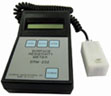
HM21-SRM Hand Held Meter with SRM Probe Head ![]() The HM21-SRM is a portable system that can accurately measure silicon tops and tails, potscrap, and ingots. The key to the simplicity of this application is the fact that setting the input current to 1mA produces a read-out value in millivolts that is numerically equivalent to bulk resistivity expressed in ohms-cm. Two factors account for the ease in which the HM21-SRM can be used for this application, as follows: 1) The HM21 four point probe electronics has a selection for setting the input current to 1 milliamp. It actually has a total of six user selectable input current choices as follows: 100nA, 1uA, 10uA, 100uA, 1mA, and 10mA. 2) The user can select to have the meter read-out in millivolts, which is equivalent to the ohms-cm value when the input current of 1mA is selected. Alternately you can use the PC software that is included with the HM21 Hand Held Meter to convert the values to ohm-cm regardless of which input current is used. For more information, click here to visit the web page for the Jandel Portable Four Point Probing System for measuring silicon potscrap, ingots, remelt.. |
P/N Typing System ![]() The Jandel Engineering model PN01 P/N Typing Unit can be used with any four point probe (linear array) to determine whether a material is P or N type. It uses the "rectification" method to determine P or N type. It is normally used with a high pressure probe (sharp tips and strong springs) to insure good contact. When used with a Jandel four point probe system, the probe portion of the system can be plugged into the typing unit instead of into the Jandel electronics. When it is to be used with some other form of four point probe, Jandel can include the male connector so that the four point probe can be plugged into the back of the PN01 P/N Typing Unit. The PN01 includes a universal AC adaptor. |
![]() The Ecopia HMS-3000 Hall Effect Measurement System is a complete system for measuring the resistivity, carrier concentration, and mobility of semiconductors. The system can be used to characterize various material including silicon, compound semiconductors, metals, oxides, etc.. One Spring Clip Sample Mounting Board is included: ![]() |
|
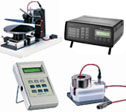
Manual Four Point Probing Equipment ![]() A complete resistivity test system is made by combining either the RM3-AR Test Unit or the HM21 Hand Held Meter with any of the following six probe units. Some of the most popular combination are shown direclty above, however, the listing below shows all of the choices that Jandel offers. Any of the probe units can be combined with either of the electronic units to make a complete system. RM3-AR Test Unit (4 Pt Probe Electronics)Combined current source and meter in one unit designed especially for the four point probe measurement. HM21 Hand Held Meter (4 Pt Probe Electronics)Hand held four point probe souce-meter with optional probe. Multiposition Wafer ProbeManually probe 1 to 9 pre-set locations on wafers up to 8" in diameter with 1mm repeatability. Multi-Height 4 Point ProbeEasily adjusts for probing materials of varying dimensions such as large substrates, ingots, wafers Microposition ProbeIdeal for sample up to 76mm (3") diameter requiring high probe placement accuracy. Multi Height Microposition ProbeRemoveable X-Y stage to provide both sample size versatility and high tip placement accuracy Universal ProbeVersatile research unit for wafers and substrates up to 76mm (3") in diameter Hand Applied 4 Point ProbeManually probe large flat panels, ingots, etc. P-N Typing UnitUse the Jandel P-N Typing Unit with any four point probe to determine whether a wafer is P or N type. |
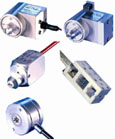
Four Point Probe Heads for All Known Systems ![]() Prometrix, KLA/Tencor, & CDE ProbesProbe heads for Prometrix, KLA/Tencor, and CDE systems. Full range of specs available including close space probes (20 mil spacing). Probes for ALL other systemsHigh quality probe heads for all known systems. Jeweled Needle Guides, Unsurpassed quality. Jandel Cylindrical Probe Jandel 4 Pin Probe Jandel Cartridge w/Lead Jandel Compact Probe Jandel Miniature Cartridge Jandel Miniature Cartridge w/6-32 tapped holes High/Low Temperature 4 Pt Probes Vacuum Chamber 4 Pt Probes Square Array (Hall) 4 Pt Probes Unusual FIVE Point Probes Close Needle Spacing Probes
Brochure (855K PDF FILE) |
Thin Film Resistivity Wafer Mapping System for wafers up to 300 mm ![]() Auto Stepping Available with Cassette-to-Cassette Fully Featured Windows Software Signatone Reliability & Quality The Signatone QuadPro Process Development Resistivity System is available in both 8" and 12" systems. The systems are motorized and can automatically step through 9, 25, 49, or 121 test points on wafers of size 100 mm, 125 mm, 150 mm, 200 mm, or 300mm. The systems use four point probes with a state of the art current source and electronic DVM combined with a dual configuration test procedure and test integration to obtain an accuracy of better than 1% over the resistivity range from 1 milli-ohm to 2 Meg-ohms per square. The accuracy and calibration are NIST traceable. The automatic system is fully integrated and operates under an MS Windows based controller. The friendly software allows one click single point measurements or one click automatic wafer mapping with the average and standard deviation displayed and either 2D or 3D maps of the results. A live display of the current test point location and result is available. If any point is suspect, it may be re-tested by clicking on the table entry, after retest, and the system allows a choice of acceptance of the new test data. The results are stored in ASCII files and may be uploaded to a host system for trend analysis through an optional Local Area Network (LAN). Other options include a light shield and the addition of a thermal chuck and temperature control and software for the measurement of the Temperature Coefficient of Resistance (TCR). |
Low Cost Four Point Probe with Meter ![]() Resolution: 0.004 ohms/sq. Accuracy: 0.01 ohms/sq. @ 1.00 ohm/sq. Resolution: 0.04 ohms/square Accuracy 0.07 ohms/square @ 10.00 ohms/square. Resolution: 0.4 ohms/sq. Accuracy: 0.7 ohms/sq. @ 100 ohm/sq. Resolution: 0.8 ohms/sq. Accuracy: 1.4 ohms/sq. @ 1000 ohm/sq. |
1 Short Application Note on Sheet Resistance, Ohms-Per-Square, and the Calculation of Resistivity or Thickness 2 Basic information regarding how to make four point probe measurements using Jandel resistivity test equipment. 3 Four Point Probe Theory - A helpful article from the University of Illinois - Urbana/Champaign 4 Four Point Probe Equations - A helpful article from the University of Illinois - Urbana/Champaign 5 Converting Ohms-per-square to Ohms-cm Converting sheet resistance measurements to values expressed as bulk resistivity
5A Calculating film thickness using a four point probe Using sheet resistance and bulk resistivity values to calculate sheet thickness.
6 Sample Size Requirements and Correction Factors
Some questions and answers from Jandel Engineering Ltd. 7 Haldor Topsoe Technical Documents Regarding Correction Factors Correction Factor for various material shapes and sizes. 8 [6 MEG FILE] National Bureau of Standards Technical Note 199, Issued April 15, 1964, "Correction Factor Tables for Four-Point Probe ResistivityMeasurements On Thin, Circular Semiconductor Samples [6068K PDF file] 9 Finite-Size Corrections for 4-Point Probe Measurements, by J. R. Senna of the Instituto Nacional de Pesquisas Espaciais (INPE), Brasil 10 Q & A regarding: resistivity & resistance, surface resistivity, sheet resistance & volume resistivity by John Clark of Jandel Engineering 11 Q & A regarding the use of Jandel Resistivity Measurement equipment by Pete Clark of Jandel Engineering 12 Four-Point Probe Theory of Operation from the University of California, Berkeley, EECS web site (PDF file). 13 A table of suggested probe tip specifications for various silicon wafer types. 14 A table of common four point probe tip radii and spacings 15 The use of osmium alloy four point probe tips versus the more common tungsten carbide tips 16 Square array versus linear array four point probe 17 Jandel FAQ 18 Application note regarding Jandel Cylindrical probe, which applies to most Jandel probe heads 19 Four point probe nostalgia |
|||
Four-Point-Probes is a division of Bridge Technology. To request further information or to place an order, please contact Larry Bridge at Bridge Technology in the USA at: (Voice) 480-988-2256, Email: sales@bridgetec.com or Fax: 480-452-0172![]() |